

Your Referral Journey at helpz
August 23, 2026
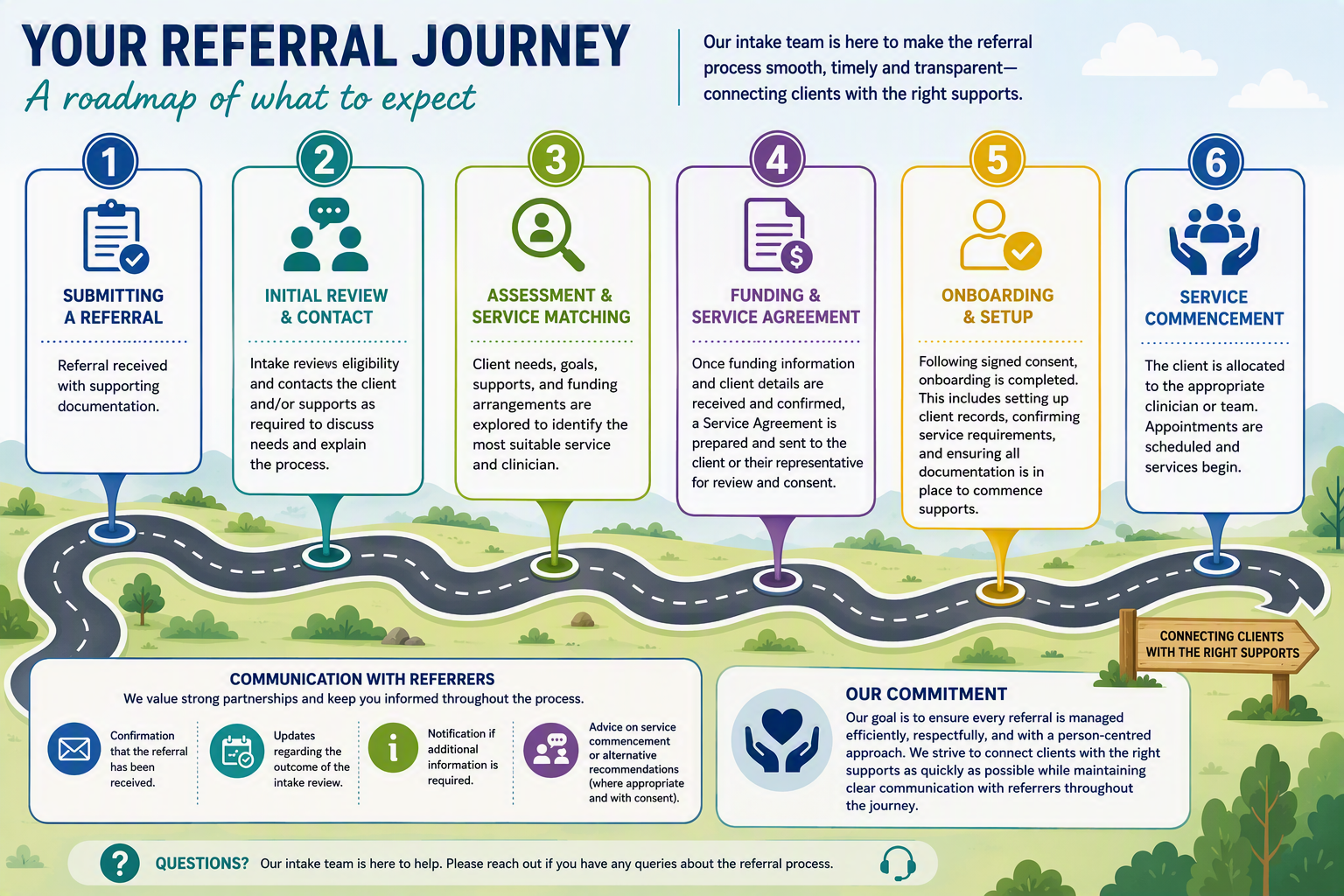
At helpz, we understand that navigating referrals can sometimes feel overwhelming. Our intake team is committed to making the process as smooth, transparent and efficient as possible while ensuring each client is connected with the right supports at the right time.
This roadmap outlines what you can expect from referral through to service commencement.
News & Insights
Check Our Latest Resources

When most people think about depression, they often picture someone who looks sad, withdrawn, or tearful. But what if depression doesn't look like sadness? What if it looks like irritability, aggression, refusing activities, changes in sleep, increased dependence on others, or a loss of interest in things that once brought joy? For people with intellectual disability, depression can look very different from what many of us expect. As a result, it is often misunderstood, misidentified, or missed altogether. People with intellectual disability experience the same range of emotions as everyone else. They experience happiness, excitement, disappointment, grief, loneliness, stress and sadness. Yet they are often less likely to have their emotional experiences recognised or discussed. Sometimes this is because communication may be more challenging. A person may struggle to describe how they are feeling, find it difficult to identify emotions, or lack the words to explain what is happening internally. Instead, their feelings may be expressed through changes in behaviour. A person who previously enjoyed social activities may start declining invitations. Someone who was once engaged and enthusiastic may appear tired, withdrawn, or uninterested. A person may become more anxious, frustrated, emotional, or reactive than usual. Others may experience changes in sleep, appetite, motivation or concentration. Because these signs can look different from traditional descriptions of depression, they are sometimes mistaken for "challenging behaviour," a personality change, or simply part of the person's disability. This misunderstanding can have significant consequences. People with intellectual disability are known to experience higher rates of mental health concerns than the general population. Yet they frequently face barriers to having these concerns recognised and appropriately addressed. Too often, emotional distress is attributed to the disability itself rather than considered as a possible mental health issue. This is sometimes referred to as diagnostic overshadowing - when changes in mood, behaviour or wellbeing are assumed to be part of a person's disability rather than signs that something else may be happening. The reality is that depression is not a normal part of having an intellectual disability. Just like anyone else, people with intellectual disability can experience periods of poor mental health, and they deserve access to understanding, support and appropriate care. One of the most important things families, support workers and professionals can do is notice change. Has the person stopped participating in activities they usually enjoy? Have they become more withdrawn? Are they sleeping more or less than usual? Do they seem less motivated, less energetic, or more emotional than usual? Often, those who know the person best are the first to recognise that something does not feel right. Meaningful support starts with listening, observing and being curious. Rather than focusing only on the behaviour we can see, it helps to consider what the person might be experiencing beneath the surface. It is also important to remember that mental health is about more than treatment. Factors such as meaningful relationships, community participation, physical health, choice and control, routine, purpose and belonging all contribute to emotional wellbeing. A good life is not simply the absence of illness. It is having opportunities to connect, contribute and engage in activities that bring meaning and enjoyment. This is why promoting mental health should be everyone's responsibility. Families, disability professionals, educators, healthcare providers and communities all play a role in creating environments where people feel valued, understood and supported. The more we recognise that people with intellectual disability experience the same emotional highs and lows as everyone else, the better equipped we are to notice when something has changed and provide support when it is needed. Because depression does not always look the way we expect. Sometimes, the most important thing we can do is look beyond the behaviour and see the person.

Every generation inherits ideas about disability. Some are helpful. Many are not. While society has made significant progress in how we understand and support people with disability, there are still misconceptions that quietly shape the way people are treated, supported and included. Often these myths do not come from a place of malice. They come from outdated assumptions, limited exposure, or a desire to simplify something that is far more complex and human. Perhaps it is time we let some of them go. Myth 1: Independence Should Always Be the Goal Independence is often presented as the ultimate measure of success. But for many people, the goal is not independence. The goal is a good life. A good life might include support workers, assistive technology, family involvement, community participation and ongoing assistance with daily tasks. Requiring support is not a failure. It is simply part of being human. All of us rely on others in different ways throughout our lives. The question should not be, "How can we make this person independent?" Instead, we might ask, "How can we ensure this person has the right supports to live the life they want?" Myth 2: If They Can Do It Sometimes, They Can Do It All the Time One of the most common misunderstandings in the disability community is assuming that ability is consistent. A person may be able to attend a social event one day and struggle the next. They may communicate confidently in one setting but find it difficult in another. They may complete a task independently when rested, regulated and supported, but require assistance when stressed, overwhelmed or fatigued. Capacity can fluctuate. Disability is often dynamic, influenced by factors such as environment, health, sensory demands, stress levels, relationships and available supports. Judging someone based on what they can do on their best day can create unrealistic expectations and unnecessary pressure. Myth 3: Behaviour Is Just Attention-Seeking When someone is distressed, frustrated, overwhelmed or unable to communicate their needs effectively, their behaviour often tells a story. Yet behaviours of concern are still frequently dismissed as "attention-seeking." What if seeking attention is not the problem? Attention can mean connection. It can mean safety. It can mean a need for help, understanding or reassurance. Instead of asking, "How do we stop this behaviour?" we might ask, "What is this person trying to communicate, and what support do they need right now?" That small shift can completely change the support we provide. Myth 4: Communication Means Talking Some people communicate with speech. Others use devices, signs, gestures, pictures, behaviours, facial expressions or body language. Communication is not measured by how many words a person uses. Every person communicates. The responsibility is not only on the individual to communicate clearly. It is also on the people around them to listen, observe and create opportunities for communication in ways that work for them. When we broaden our understanding of communication, we broaden opportunities for connection, choice and self-determination. Myth 5: Disability Is Always Visible Many disabilities cannot be seen. Autism, ADHD, intellectual disability, psychosocial disability, chronic pain, acquired brain injury, neurological conditions and many health-related disabilities may have little or no obvious physical indicators. Because of this, people are often told they "don't look disabled." The reality is that disability is not defined by appearance. Someone's support needs, challenges and lived experiences remain valid whether those differences are visible or invisible. Myth 6: People With Disability Need to Be Fixed Perhaps the most harmful myth of all is the idea that disability is a problem that needs solving. Many people with disability are not looking to be fixed. What they want is understanding. Accessibility. Choice. Respect. Opportunity. Meaningful relationships. Communities where they belong. The barriers people face are often not created by their disability, but by environments, systems and attitudes that fail to accommodate human diversity. When we focus less on changing the person and more on changing the barriers around them, inclusion becomes possible. Let go of the myths Letting go of these myths does not mean ignoring challenges. Disability can involve genuine difficulties, support needs and barriers that require thoughtful responses. But when we replace assumptions with curiosity and judgment with understanding, we create space for something more important than awareness. We create acceptance. And perhaps that is where meaningful inclusion truly begins.

Most people think of disability in terms of the challenges they can see. They might notice a mobility aid, a support worker, a therapy appointment or a visible difference in how someone communicates, learns or moves through the world. What they rarely see is the work happening in the background. The forms. The phone calls. The appointments. The waiting lists. The reports. The advocacy. The explaining. The repeating. The planning. The worrying. For many people with disability and their families, managing disability can feel like a full-time job. One that nobody applied for. One that has no annual leave. One that does not finish at the end of the day. Behind every support a person receives is often a long process of coordination and administration. Families may spend hours organising appointments, communicating with providers, navigating funding systems, responding to emails, attending meetings and ensuring supports are working as intended. A simple change in circumstances can generate a surprising amount of work. A new therapist. A school transition. A support worker leaving. A funding review. A change in health needs. Each can trigger a cascade of meetings, paperwork and decision-making. For many people, this work occurs alongside all the usual demands of everyday life. Parents are still parenting. People are still working. Families are still managing finances, relationships, household responsibilities and their own wellbeing. Yet hidden beneath it all is an additional layer of responsibility that often goes unrecognised. There is also the emotional labour. Advocating for support can be exhausting. Having to repeatedly explain a person's needs, justify access to services or provide evidence of challenges can take a significant toll over time. Many families become experts in systems they never expected to learn about. They develop knowledge of funding processes, legislation, assessments, therapies and service pathways simply because they have had to. Not because they chose to. Because someone needed to. What is remarkable is how often this work is done with extraordinary determination. Families continue showing up. Participants continue advocating for their goals. Support networks continue navigating complex systems because they know what is at stake. Opportunities. Safety. Independence. Quality of life. A future that reflects the person's hopes and aspirations. Recognising this hidden work matters. It reminds us to approach people with empathy. To understand that a delayed phone call or missed appointment may not be a sign that someone does not care. It may simply mean they are juggling far more than we can see. It reminds us that support is about more than providing a service. It is about reducing burden. Making systems easier to navigate. Helping people feel heard. Sharing responsibility where we can. Most importantly, it reminds us that behind every participant is a person living a life, not managing a case. A person with interests, dreams, relationships, strengths and ambitions. Because while disability may be part of someone's story, it should never become the entirety of it. The goal is not to spend a lifetime navigating systems. The goal is to spend a lifetime living.