
Tharon’s Thoughts - Employment for Autistics

By Tharon
Neurodivergent Consultant at helpz
Employment for Autistics
Late diagnosis does not change the core support needs autistic people have lived with since childhood, but it does highlight the needs and bring a new awareness. What does change are society’s expectations. Children are supported. Adults are expected to be independent, and a large part of that independence is maintaining employment. Yet the sensory, emotional and cognitive needs we have as children do not magically disappear when we turn eighteen. They follow us into adult life, this includes every workplace we enter.
Many autistic adults, late diagnosed or not, grow up believing their passions are not possible careers simply because the environments surrounding those passions are overwhelming. I always loved food and once considered becoming a chef, but a commercial kitchen is a sensory storm: the noise, the tight spaces, the constant movement. After one day in that environment, I would be wiped out for an entire week. Sustained exposure to sensory overwhelm drains us so quickly that each day becomes harder than the last. Sleep difficulties, experienced by many neurodivergent people, add another layer of challenge and can make early morning shifts almost impossible to manage.
Barriers to employment often begin long before someone steps into a workplace. Many autistic people struggle in school, not because they cannot learn, but because information is not provided in ways that suit their brains, and environments can be toxic due to bullying and social factors and the systemic design of school not being designed for the neurodiverse brain. When adulthood arrives, job interviews become the next barrier. Research shows that autistic candidates are often screened out long before their skills are considered, because interviews test social performance rather than capability. Neurotypical interviewers instinctively rely on subtle social cues that autistic people do not display, and this creates an unfair disadvantage. Even highly capable autistic candidates may not make it past the very first stage.
Those who do gain employment often succeed because they are skilled at masking. Masking helps us blend in, but it is incredibly exhausting. It uses a huge amount of cognitive and emotional energy; energy we then lack for actual job tasks. This can lead to burnout that lasts days, weeks, months, or even years. Burnout does not remove the reality that we still need to pay bills, maintain housing and meet obligations, even when our internal fuel tank is empty (we have run out of spoons!).
Late diagnosis brings another challenge. When people finally understand their brain and allow themselves to stop masking (or at least try to build a healthy mask), there can be a period of unravelling. Skill regression, emotional overload and a sudden awareness of long ignored needs can appear all at once. It is not weakness. It is finally stopping the lifelong sprint, and changing to something more sustainable and balanced.
Yet meaningful employment is possible when environments embrace differences instead of working against them. My own experience is proof. I did not seek out a career at helpz. Instead, I crossed paths with our Managing Director, Danny, who noticed strengths in me that I had never identified in myself. He created a role that aligned with my abilities and passions, one that allowed me to use the knowledge I have gathered from a lifetime of observing and understanding myself and other people. It showed me that employment does not always arrive in the expected way. Sometimes the right environment brings out capabilities we did not even know we had.
Many autistic children demonstrate deep, passionate interests that we often dismiss as hobbies. But those interests can grow into sustainable careers when embraced and utilised early. The key is removing neurotypical expectations about what work “should” look like. There is no universal pathway to success. If we nurture passions and build skills around them, the results can be extraordinary.
The reality is that sensory needs do not disappear at the office door. An autistic brain absorbs every sight, every sound, every smell and every movement with equal intensity. While trying to listen to one conversation, we are simultaneously processing all the others in the room – we cannot turn this off. To a neurotypical person, attention is like being a rock in a flowing stream. The water moves around them and does not disturb their stillness. For an autistic person, attention is like being a sea plant under that water, pushed in every direction by every current. This is how our sensory world feels, and it makes focusing in chaotic environments extremely difficult.
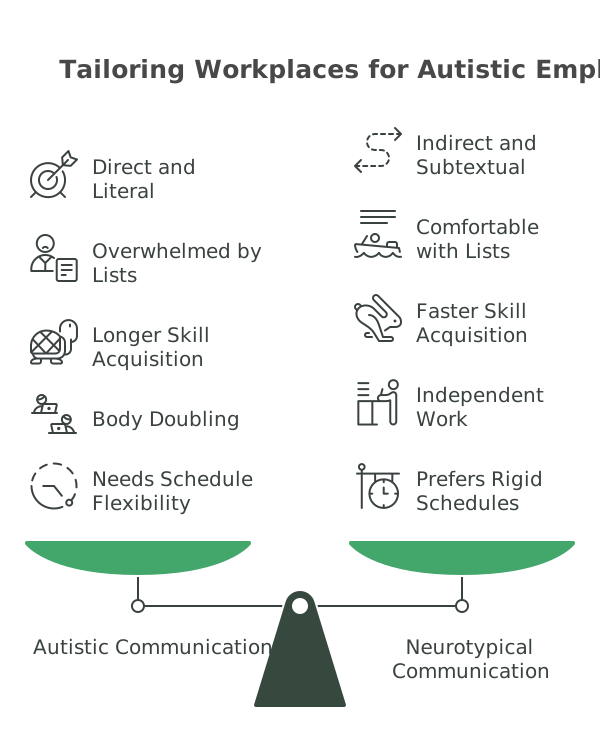
Workplaces can make a world of difference by understanding this. Autistic communication tends to be direct, literal and free from social subtext. Instructions need to be clear and specific. A long list of verbal tasks can be overwhelming, so shortening the list, or writing things down helps greatly. Learning new skills may take longer, but once mastered, autistic employees are often exceptionally reliable and thorough with a skill level equal or greater than those who taught us. Many of us work best when someone is nearby doing similar tasks, a form of body doubling that helps anchor our focus. Overwhelm is common, but short breaks allow us to reset and return with full productivity.
Most autistic people are not built for rigid nine to five schedules, but with flexibility, reduced hours, or sustainable pacing, we can thrive. The most effective strategy is simple: ask the person what they need.
In education, special interests are one of the most powerful tools we have. If a child loves birds, use birds to teach maths. Let them read and write about birds to build literacy skills. Evidence consistently shows that when autistic children engage through preferred interests, learning becomes more accessible, motivating, and regulated.
Special interests and hyperfocus also play a central role in emotional regulation. They help us stay grounded, reduce sensory overwhelm, and stabilise mood. Research indicates that being able to engage in self‑regulatory behaviours, including focused interests or stimming, directly increases a person’s sense of control and wellbeing and ability to engage in social situations. Conversely, stopping abruptly can be very difficult. Imagine a train moving at full speed; it cannot stop on demand without risk of it being derailed. That’s what it feels like for us when we’re asked to disengage suddenly.
Most of us prefer to explore our interests alone during the “deep dive,” but once we’ve gathered the knowledge, we love to share it, especially with people we trust or trying to build a connection with. Asking about a special interest is an invitation into our world, but it comes with a warning: if you ask, be ready for a flood of information. This “info‑dumping” is a form of connection. Special interests often correlate with enthusiasm, emotional expression, and social bonding within autistic communities. Stopping mid‑stream is hard, not because we’re ignoring social cues, but because the cognitive momentum is still moving, just like the train metaphor used above. So, pull up a seat – you may be listening for a while.
Gaming is another area where special interests often settle, especially for neurodivergent kids. Games offer structure, predictability, and a rewarding feedback loop that mirrors the satisfaction of special interests. Game‑based interventions have been shown to improve social skills, cooperation, communication, hand-eye coordination, and cognitive flexibility among autistic children. Online play can also create low‑pressure opportunities to build team skills, and social connection without the intensity of face‑to‑face interaction.
But gaming also comes with risks. The concept sometimes referred to as “digital dementia” has been debated widely. Some studies suggest excessive passive screen time may negatively affect memory or executive functioning in young people, including literal shrinking of the brain. Some games are deliberately developed to become addictive to encourage game play to continue, similar to the effect of poker machines. However, other studies show, that digital technology use in adults may actually support cognitive resilience rather than harm it. What we do know is that brains can form intense neurological reward loops around digital interests, making moderation essential to avoid addiction.
And moderation is the key across all special interests. Children should be supported to engage in their interests, not shut down, but they also need guidance in balance, priority‑setting, and recognising their own energy limits. These skills become powerful lifelong tools. Working with the brain, not against it, is how we help neurodivergent children (and adults) grow in healthy and sustainable ways.
Most importantly, special interests are a bridge between the neurodivergent and neurotypical worlds. Autistic and ADHD people often find it hard to enter neurotypical social spaces, not because we don’t want to, but because we don't always know how. But when someone steps into our world, asks about our interest, shows genuine curiosity, we see the effort, and it matters. It opens the door for connection. And once that door is open, we're far more likely to walk through to meet you.
Reference:
Bernardin, C.J., Brown, C. & Kanne, S. (2021) Characterization of Special Interests in Autism Spectrum Disorder: A Brief Review and Pilot Study Using the Special Interests Survey. Thompson Center for Autism & Neurodevelopmental Disorders. Available at: https://thompsonfoundation.org/wp-content/uploads/2021/10/Research-SpecialInterests-pre-pub.pdf (Accessed 21 January 2026). Navigating Social Connections for Autistic Individuals
News & Insights
Check Our Latest Resources